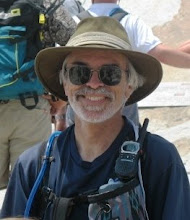
Aware
Today I am aware that a good share of the time I am not. But to the extent that I am, it is generally a good thing.
Perhaps it is because we live in a world of sensory overload, that we become so good at filtering things out. Perhaps it is because we have allowed ourselves to be hoodwinked into thinking that multi-tasking is a virtue that the successful should cultivate, so we learn to dilute our ability to attend or focus on a few things (or just one thing) well, until it seems normal to us to live superficially with our attention disbursed over many things - much like how a stone skipping across the surface of the water may have the illusion that is experiencing the depths of a lake.
It is partially because I am aware that I often am not aware, that I so look forward to the Journey retreats that I get to participate in about 3 times a year. (See note a the bottom of this post). Our first day together always involves spending the major part of the morning and afternoon in unhurried alone time with God. This morning, before getting started with that, we gathered together as a group to reflect on the Psalms as guides to prayer - noting the richness and power of the poetry and its imagery, not so much to communicate information, but to engage our experience on deeper levels - to raise our awareness of the ways God connects with us, and we with God. We were reminded that poetry like this is not just "decorated language," but is something designed to reach in and resonate on levels that we find difficult to access in other ways.
And so begins today's journey for me. With the Psalms in hand, and a newly acquired book on the Celtic Way of Prayer that I had just come across this morning, I have been walking, reading, reflecting, praying and enjoying the un-rushed, unhurried time. And while I am sure there are many important aspects of awareness of which I need to be more aware (stuff for future posts, no doubt), for this particular morning, these are a few of the things that have caught my attention along the way:
First, as I was looking through the book, I was intrigued as I was reminded that central to Celtic Christian Spirituality is also the concept of the journey, (which shares a common metaphor with the retreat experience I am participating in). I am also reminded that, far from this being an image of directionless drifting with no meaningful purpose in mind, the journey metaphor recognizes that life is not the destination we move towards, but what we experience along the way. The process is the destination, and we need to embrace each step for what it is. This involves being attentive and living in awareness of the richness of what we are experiencing along the way - a huge part of which is a recognition of the way God is present and speaking with us, around us, and even within us as we travel.
Second, as I continue to browse through this book, I read about how a profound sense of awareness was something that was already deeply woven into the culture of the Celtic people even before they heard the story of Jesus and embraced Christianity. They already had a sense of the presence of divine power in their world, and had experienced the powerful, enriching, transforming impact that their close appreciative relationship with creation brought them. They correctly discerned the footprints and the sustaining power of the Creator in the midst of creation, even if they erred by mistaking the foot prints for the Person, and as a result failed to fully discern the nature and character of Artist whose work they so deeply appreciated. But even so, they were attentive and responsive to what they sensed around them in amazing ways.
As I thought about this, I was reminded of Paul's experience in Athens, recorded in Acts 17 where, when he found himself in the midst of a culture that had produced many temples to a variety of gods, instead of attacking their idolatry, he acknowledged, and perhaps even affirmed, their religious impulse, and then sought to re-direct it by entering into a conversation with them about the god they did not yet know. Perhaps spiritual responsiveness (awareness) is something we can experience even when our picture of the God is not yet fully formed, or we know that it is the Spirit that we are actually responding to?
Even now, as I am enjoying my walk through some beautiful mountain scenery, I do so with a realization that my level of perceptiveness and awareness is probably much less than than theirs would have been. And so I wonder, if, while we probably do well to notice what ancient Celtic culture may have gotten wrong, it would be sad indeed if we did not appreciate and learn from what they got right. In their attentiveness to the world around them, they discerned and appreciated much that we easily miss.
I also find myself wondering if some sadness is not also appropriate for the way that, over the years, (because some of the practices, customs or patterns of living that reflect a deep respect for nature can be traced back to a time when Christian ideas were either not yet known, or were not flourishing), some have concluded that they are somehow inherently inappropriate or evil -- rather than noticing how these things were transformed once the message of Jesus was received, and difference between art and Artist made clearer? Perhaps it is possible that we don't need to choose between appreciation for the Artist and sensibilities that honor the artwork as much as we may have thought, but only to place them in their proper relationship, preserving the richness and value of both? It makes me wonder . . .
- I wonder if It is when we fail to do this, that we run a significant risk of ultimately diminishing the value and meaning of both?
- I wonder why it is that when some hear an ancient Christian Celtic prayer that uses imagery that recognizes the power and presence of God in the created world, that we can be quicker to point out how the language shows the marks of a pre-Christian past, than we are to see how the sense of awareness this culture has cultivated has been transformed and expressed in response to the Christian God they have now come to understand and serve?
- I wonder how much we, at times at least, suffer from misplaced suspicion that leads us to strain at gnats without noticing that may be choking on camels?
And so, as I continue to walk, pausing for awhile to listen to the wind in the trees, feel the sun on my face, noticing both sound and silences, and the intricate artistry displayed in both the large and small things that are alive and growing around me, I am reminded again how infrequently I pause long enough to be as aware as I might be, and how much more I see when I do.
Thumbing through the Psalms, I come across places where this group of Hebrew believers, in a way that expresses not only the cultural heritage that had shaped them, but also the God Whose presence and character had been revealed to them in a more personal way, give expression to their faith. Among them are these:
Psalm 19: 1-4 (NIV)
The heavens declare the glory of God
the skies proclaim the work of his hands
Day after day they pour forth speech;
night after night they display knowledge.
There is no speech or language
where their voice is not heard
Their voice goes out into all the earth,
their words to the end of the world.
Psalm 1:1-3 (NIV)
Blessed is the man who does not walk in the counsel of the wicked
or stand in the way of sinners
or sit in the seat of mockers
But his delight is in the law of the LORD,
and on his law he meditates day and night.
He is like a tree planed by streams of water,
which yields its fruit in season
and whose leaf does not wither.
Whatever he does prospers.
Psalm 36 5-9 (NIV)
Your love, O LORD, reaches to the heavens,
your faithfulness to the skies.
Your righteousness is like the mighty mountains
your justice like the great deep
O LORD, you preserve both man and beast
How priceless is your unfailing love!
Both high and low among men find refuge in the shadow of your wings
They feast on the abundance of your house;
you give then drink from your river of delights.
Psalm 42 1,2, 7 (NIV)
As the deer pants for streams of water,
so my soul pants for you, O God.
My soul thirsts for God, for the living God
When can I go and meet with God? . . .
Deep calls to deep in the roar of your waterfalls;
all your waves and breakers have swept over me . . .
For with you is the fountain of life
in your light we see light
And then, from these Psalms that express such a close connection with nature as a place where God's presence and activity can be glimpsed, looking through the book on Celtic Christian prayer, I find selections like these: (taken from the book mentioned above and referenced below):
Bless O Lord the food we are about to eat and we pray you O God may it be good for our body and our soul and if there is any poor creature hungry or thirsty walking the road may God send him in to us so that we can share the good with him- just as He shares his gifts with all of us.
(And this prayer for cattle)
Pastures smooth, long, and spreading, Grassy meads aneath your feet, The friendship of God the Son to bring you home To the fields of the fountains . . . Closed be every pit to you, Smoothed be every knoll to you, Cosy every exposure to you, Beside the cold mountains.
(and this hymn)
Bless to me, O God The earth beneath my foot,
Bless to me, O God, The path whereon I go;
Bless to me, O God, The thing of my desire
Thou Evermore of evermore,
Bless Thou to me my rest.
Bless to me the thing Whereon is set my mind,
Bless to me the thing Whereon is set my love;
Bless to me the thing Whereon is set my hope;
O Thou King of kings Bless Thou to me mine eye!
It has been a good time for walking, reflecting, praying, and being just a bit more aware than I was when I began, particularly . . .
- of the extent to which I too often live less aware than I should
- of how much there is to notice (and enjoy) when I take the time to pause, listen, and pay attention
- of the reality that those who are willing to pay attention, may actually be more responsive to the recognition of God's presence in the world, than some who may be Christians but live in ways that are largely unaware. (This may mean that there are great opportunities here to both learn a lot about what it means to live with greater awareness from those who do, and to share a clearer picture of the kind of God revealed by Jesus with those who may not know.)
- and maybe even that, among those who fear "end time deceptions" of some sort, perhaps less worry ought to spent over those who seek to focus our attention on a greater awareness of God's gracious presence in the world and inviting us to live in ways that are both appropriate and responsive, and rather be more concerned about those forces than band together to dull those perceptions by offering a "beast like" (in the apocalyptic sense of the term) alternative that invites an entirely different kind of response.
- And perhaps most of all, an increased appreciation for what Paul says when he speaks of "
The God who made the world and everything in it [as] the Lord of heaven and earth . . . [Who] did this so that men would seek him and perhaps reach out for him and find him, though he is not far from each one of us. For in him we live and move and have our being." Acts 17:24, 27-28 (NIV)
NOTE ON THE JOURNEY RETREATS: These are a series of two day retreats, which are jointly sponsored by Southeastern California Conference and The Leadership Institute for pastors to have protected, unhurried time to spend alone with God, reflecting on our own spiritual formation, and on how healthy spirituality informs and intersects with ministry - a wonderful gift our Conference provides for us, the value of which I cannot adequately express here . . . but if you'd like to know a little more about it, you can read more here.
NOTE: For those interested, the book I am looking at today is "The Celtic Way of Prayer" by Esther De Waal.